Collocations: Make and Do

Do you know all these collocations of ‘make’ and ‘do’?

make do collocations

Posted in Easily Confused Words | Tagged , | Leave a comment

English Verb Tenses: Past Simple

Need help with the tenses in English? Here’s an excellent overview of the Past Simple with links to additional exercises.

Past Simple info sheet

Here are some speaking exercises to practise: Past Simple exercises.

Here is a worksheet to practise building Past Simple questions. Build the questions first using the prompts and then practise the role plays with a partner: Finding Out.

Posted in Grammar, Tenses | Tagged , , | Leave a comment

English Verb Tenses: Present Continuous

Need help with the tenses in English? Here’s an excellent overview of the Present Continuous with links to additional exercises.

Present Continuous info sheet

And here’s a handy visual aid from http://www.perfect-english-grammar.com/

Present Cont chart chart

Posted in Grammar, Tenses | Tagged , , | Leave a comment

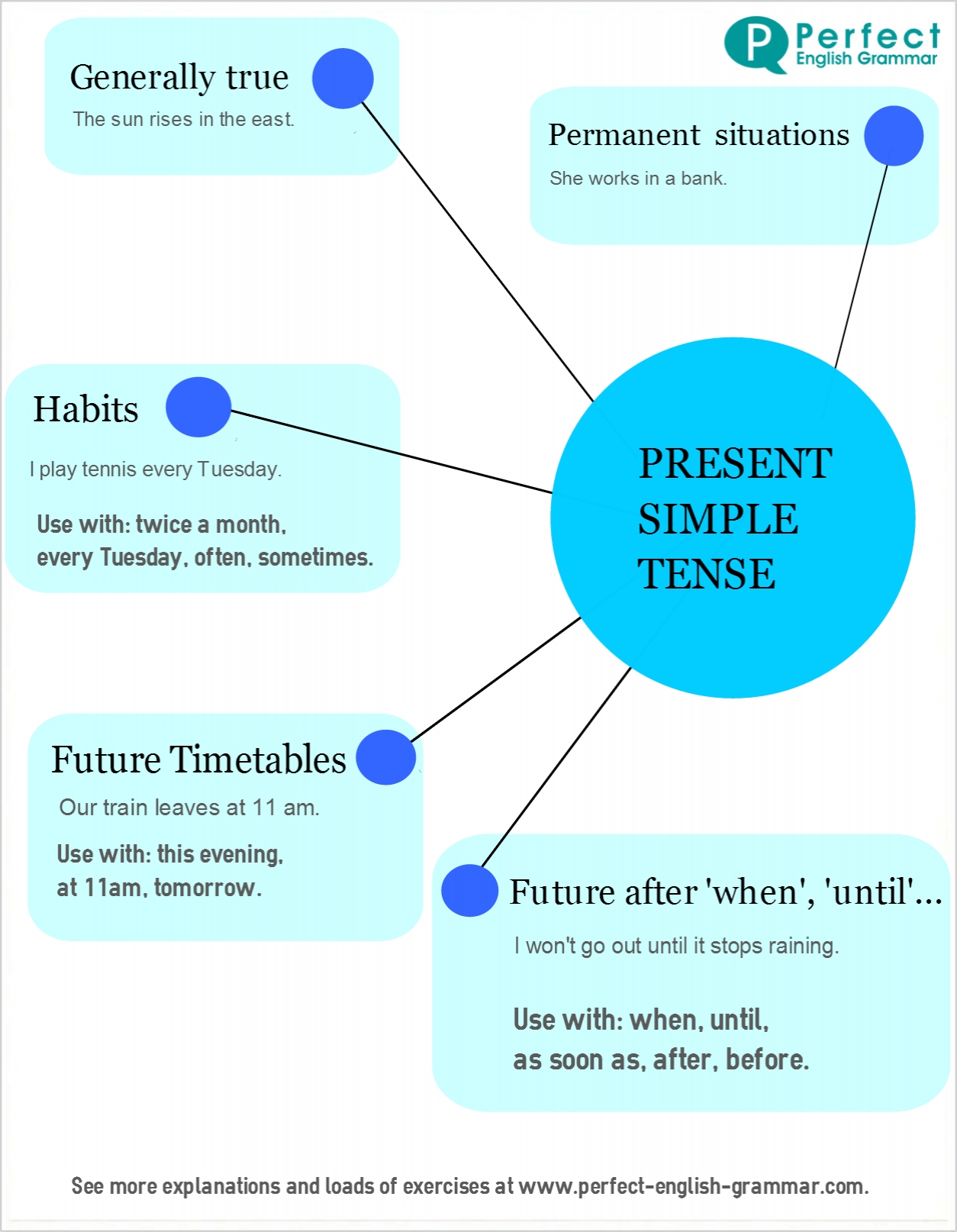
English Verb Tenses: Present Simple

Need help with the tenses in English? Here’s an excellent overview of the Present Simple with links to additional online exercises.

Present Simple info sheet

And here’s a handy visual aid from http://www.perfect-english-grammar.com/

Present Simple chart

Posted in Grammar, Tenses | Tagged , , , | Leave a comment

Top 100 English Verbs

Below is a link to an excellent website with the top 100 most common verbs in English. You can also click on each verb to see the full conjugation pattern. Go learn them!!

http://www.linguasorb.com/en/english/most-common-verbs


Posted in Grammar, The Basics | Tagged , | Leave a comment

e.g. / i.e. : what’s the difference?

The Latin abbreviations e.g. and i.e. are commonly used in English, and nearly as commonly mixed up. Below is a clear explanation, which can also be found online at it’s original home: http://www.elearnenglishlanguage.com/difficulties/egie.html.

I should also point out that these days you can write both ‘eg’ and ‘ie’ without any periods. The only exception would be when writing a legal English text, at which point you should maintain the periods. Notice as well that you need to use a comma after both abbreviations.

e.g.

e.g. stands for exempli gratia, which means “for example.” Use e.g. to introduce one or more possibilities among many.

I like root vegetables, e.g., potatoes.
(Potatoes are just one of many types of root vegetables)

He wastes his money on junk, e.g. cars that don’t run.
(He also buys old TVs and VCRs)

I’ll listen to anything, e.g., country-western, rap, light jazz.
(Country-western, rap, and light jazz are just a few of the many types of music that I’ll listen to)

An easy way to remember what e.g. means is to think of it as standing for “example given.” Alternatively, just say “eg” out loud – it sounds just like the first syllable in example.
i.e.

i.e. stands for id est which means “that is.” Use i.e. when what you are introducing is equivalent to or an explanation of what comes before it in the sentence.

I like root vegetables; i.e., the ones that grow underground.

He wastes his money on junk; i.e., stuff that he will never get around to fixing.

I’ll listen to anything; i.e., I like any kind of music.

Basically, i.e. means “in other words.” It’s used to reword or provide an alternate explanation.

Posted in Business English, Easily Confused Words, Legal English, Punctuation, Writing | Tagged , , , , , , , , | Leave a comment

Recommended Apps: Phrasal Verb Workout

Phrasal verb workout

https://itunes.apple.com/us/app/phrasalverbworkout/id570386473?mt=8

Now you can practice your phrasal verbs on the run 🙂

Posted in Apps for English Learning | Tagged , , , | 2 Comments

unsatisfied / dissatisfied: what’s the difference?

Dissatisfied applies only to people who are unhappy, frustrated or disappointed with a thing, person or situation.  Examples:

  • I was dissatisfied with the service I received at the restaurant.
  • She was dissatisfied with his response to her question.

Unsatisfied refers to the feeling of needing more and can be used with abstract items. Examples:

  • Despite the hearty meal, his hunger remained unsatisfied.

If you would like more example sentences please visit the British Corpus. Type your word in the search field and it will bring up examples of the word in use. A fantastic tool!

http://www.natcorp.ox.ac.uk/

Credit where credit is due: I sourced this explanation from here http://www.dailywritingtips.com/dissatisfied-unsatisfied/

Posted in Easily Confused Words | Tagged , | Leave a comment

on time / in time: what’s the difference?

What is the difference between on time and in time?

‘In time’ means to be at the edge of the specified time, with no spare time left.
‘On time’ means to be punctual, with spare time left.

To clarify that here are two examples:

I arrived just in time to catch the train. (So any later and you would have missed it).

I arrived at the station on time (So you had time to spare and spent some time actually waiting for the train).

In time is frequently used with the word ‘just’ as in our example above. See the British Corpus for more examples: http://www.natcorp.ox.ac.uk/

Posted in Easily Confused Words | Tagged , , , | 1 Comment

Sites for online Tandem language exchange

Try them out and let me know what you think!
Posted in Speaking | Tagged , , | 1 Comment